Monday, June 4, 2012

Searching For The Elephant

It's been a great ride, but now it's time to move on to new pastures... So to all of the faithful readers and followers of Swimming In India... thanks so much for your comments, feedback and patience over the past 3.5 years. I've enjoyed every minute of it!

Check out the continuing adventures and observations from our humble American family in Austin, Texas.  Please join us on...  Searching For The Elephant.


All the best!    -- HouseBoy.

Thursday, May 31, 2012

The Last Ride

Audrey and Lesa had a great last riding lesson this past Sunday morning at the Delhi Riding Club...
Although it was hot and dusty, the "sir" gave them both extra pointers for riding with one hand and gave them each a few extra laps of cantering.
 Ms. Beeru, the club's proprietor, was in her glory, shouting orders at the stable boys and sharing her many stories with Evan and me while we sipped our pipping-hot glasses of sweet, milk chai.
It was a such a pleasant morning to cap off the last two years of riding lessons in that quiet grove of trees behind the huge, 18th Century Safdarjung tomb.

Friday, May 18, 2012

Audrey in the Studio

Audrey had her first big gig as a voice-over artist this afternoon. She recorded several takes for the introductory and concluding narration of our short documentary, "Champa Mera Sathi."
Her voice will be a part of the North American version of the film. Audrey got to record in the sound-proof studio, and work with the sound team at Mahatta Media Studios:
Sound Engineer Nittin, Lead Sound Engineer Swapan, and my Recording Manager & good friend, Prachi. Here's a BIG "thank you" to the Mahatta staff for all of their help and professionalism! It was a nice opportunity for Audrey... She had a lot of fun today!

Wednesday, April 25, 2012

Home Delivery

Thought I'd share how our kitchen gas has been delivered to us for the past three and a half years. Door to door service for compressed natural gas (CNG). We have two of these: one stored under our kitchen counter and a spare kept out on the back balcony.
 Of course with the addition of piped natural gas, these cylinders will be a thing of the past. Can you imagine the weight of one of these bicycles when they are fully loaded? No doubt these delivery guys have very strong legs!

Monday, April 16, 2012

Attack of the 100 ft Hanuman

Karol Bagh is a crowded marketplace in North Delhi. It's mostly known for the repair of mobile phones and for "cracking" US purchased iPhones. It is one of those a great places to explore once you have become a bit more comfortable with the characteristics of life in urban India. I had to make a trip up to Karol Bagh last week to have a replacement battery installed in Evan's first-Generation iPod Touch. The trip was a success, and relatively uneventful - not the first time I'd been up there. But this time I thought I'd share one of my favorite scenes along the the way to that part of Delhi - the giant statue of Hanuman.

For those not in the know - Hanuman is really the original superhero.  His story dates back thousands of years. Without going into much detail, Hindu's believe him to be the seventh incarnation of Vishnu - half human, half monkey. He is strong (known for lifting entire mountains), has the ability to fly and has a huge mace to smite his enemies with. Vishnu fights for the little guy - and despises cheats and thieves. He is a very inspiring character. The tales of Hanuman's exploits are filled with heroism and bravery...

But to see Hanuman standing in all his glory beside a highway flyover in North Delhi - I've got to say, this pretty much takes your breath away - especially when you're not expecting him to be standing there, towering over you. To give you an idea of the size of this particular statue - Hanuman's mace could probably reach from the ground to our second story balcony.

He's a big boy...


Thursday, March 29, 2012

Home Improvements?

I had to share these images... our landlords have provided us with several modern conveniences to modernize our lifestyle here in India. The execution of these improvements? ...well, I'll let you decide.
First up - additional power plugs in the kitchen. We have three countertop plugs instead of two. Nice.

Second - this is a big one - piped gas. This will replace our use of CNG cylinders. Perhaps you'd forgotten that we cook with what is essentially a camp stove with a propane tank stowed under the counter? Of course, the new meter was very stylishly placed above the counter top against our lovely tiled back-splash and granite counter-top. The meter installation caused us to lose one of our normal kitchen plugs (hence the lovely new plugs shown above) because it was too close to the new gas line.
Always thinking about our safety. I did ask the required question: "Why didn't you just place the meter under the counter?" The response was a pleasant smile and head waggle.

Third - We now have a new security camera/intercom/automatic door release system to replace the old one that hasn't worked for the last four months.  This is actually great - we live on the third floor (second if you're from India). Access to the outside is through a large door at ground level with an electric lock. If a visitor comes they can ring our flat from the street. The camera and intercom turn on and, voila, we can let them enter by releasing the door-latch with a remote button. The monitor is nice - widescreen and in full color. Again, though, it was the execution of the plan that seemed to get in the way.

Please note the power plug mysteriously wired to the water pump switch. Water pump switch you ask? Another wonderful gadget  - the main tank on the roof doesn't refill automatically. When there is no water for a morning shower we must turn on the switch to fill the tank. Then, of course I forget to switch it off and the neighbor's staff come and yell at me when the tank overflows... as if I somehow know the tank is full.

Interior home aesthetics reign supreme.  I did ask the four guys that installed this mess if someone might be coming to repaint:
Smile, head-waggle, "Ha, ha" (Yes, yes).... too-mah-row."

To be honest, life without expectations is quite refreshing most of the time.


Tuesday, February 28, 2012

Kids and Elephants - Final Day on Location

We completed our final day of filming last week. The goal was to gather a few children - mostly below the age of ten, to capture their thoughts about elephants on film. Akram (mahout) and Champa met us at the Peace Pagoda early one morning.
The Pagoda is a large Buddhist Stupa on the Ring Road a few kilometres south of where Champa stays. We pre-arranged to have some children and their parents meet us at the monument for filming. The kids represented multiple countries - India, the United States, Japan and the UK. They had a chance to meet and touch Champa, give her bananas (Champa loves bananas) and, of course, go for a ride.
Once set up, we first interviewed the children one on one - questions included "What do elephants eat?" "How do elephants take a bath?" and "What do you think about when you see an elephant?"  The session was very fun. It was a beautiful day and our location was next to a large public playground where there were many local school-children playing. Taking advantage of this, with the permission of their teachers, we recruited two more children to participate in our interviews.
What really impressed us was the security staff at the Peace Pagoda. They obviously love elephants as much as we do. Without our asking, two of the guards brought Champa a large bundle of fresh Peepal leaves for her to eat while she waited between takes.
They delivered the bundle with big smiles on their faces! The guards knew just what to bring Champa, because the Peepal is one of her favorite trees to eat.
As you might imagine, we tend to draw a crowd whenever we film Champa and Akram. This day was no exception. Tourists from all over India and the world - from places as far as Nigeria and Russia - came over to greet the big elephant, touch her and have their photos taken with her.  I had to do a bit of crowd control so we could complete all of our shots - we only had permission to film the elephant for about 4 hours.
Despite the crowd and noise, we completed all of our planned shots and even managed to record Akram for some additional audio narration. Aside from a small introductory voice-over, our short documentary is entirely narrated by Akram Khan.
We are currently working on the rough edit of the film. If all goes well, we plan to present a rough-cut to one or two focus groups by the end of March. The film will then be sent to Croatia for a final cut and edit.

Thursday, February 16, 2012

Filming becomes Farming

Lesa joined Pradeep and me on our third day of location filming last week. It was a scheduled shoot to film Champa the elephant and her mahout, Akram. Lesa came along to see what our documentary project was all about. We gladly put her to work. She helped with lighting and sound and provided us with a little moral support. On this particular day we followed Champa on her route to a nearby sugar cane field. We wanted to capture the process of how this favorite elephant-fodder was cut, gathered and loaded. Akram offered Lesa a ride on Champa's back on the way to the fields - of course she didn't hesitate to accept...
After about a three kilometer walk, we arrived at farmers' fields.  We set up for filming, but it wasn't long before Lesa somehow got side-tracked... It's not that she wasn't interested in what we were doing... in all honesty, watching a man cut down 300 kilos of sugarcane is a pretty dull, repetitive experience. All we really  needed was a few minutes of good footage, but the process took over 2 hours in the hot sun... Of course this is India, and no matter where you are, there are always people, and there is always something going on... The locals caught her eye, and Lesa got lost for time in the activities of the little village.
First it was babies. Two sisters insisted that she hold a young infant, named Ismail. They were very happy about it - they giggled and commented about the attention Lesa gave to their cute baby. As she held him, Ismail promptly smiled up at Lesa, which made the two sisters laugh and giggle even more. It was a nice connection.
After she gently handed the baby back to her mother and auntie, Lesa then made the mistake of showing interest in what another nearby woman what was planting.
We were standing in a sandy flood plain at the edge of the Yamuna River. The soil was neatly tilled with rows of little ridges for planting seeds. Once she understood what my wife was asking, the woman showed Lesa a container of small seeds - red lentils (dal). She led Lesa by the elbow out into the field and demonstrated how to plant the lentils. She placed one seed in each of many prepared holes along the tilled rows of dry, sandy soil.
Her husband was obviously amused at the sight of "Madame-Ji" learning how to plant lentils. He walked over and with a mix of Hindi, hand gestures and a few English words, explained that, once planted, he would flood the field by opening a channel from a small irrigation canal nearby. The husband and wife were a cute, surprisingly loving couple. They clearly cared for one another.
Without hesitation, and with plenty of laughter and encouragement, the couple set Lesa to work planting seeds. Twenty minutes of planting was enough for Lesa. Stooping in the hot sun has it's limitations. But I'm sure her participation in the day's planting gave the farmers a great story to share with their neighbors in the village that evening!
The photo shoot was finished and Champa, with Akram's guidance, had loaded herself with hundreds of kilos of cane. The three of us stowed our equipment and said our goodbyes...
But before we left, the farmer's wife returned with a big generous smile on her face. She handed Lesa a bundle of beautiful, fresh white radishes - a gift for "Madame-Ji," and many thanks for her help in planting the lentil crop.

Monday, January 30, 2012

Planting Trees

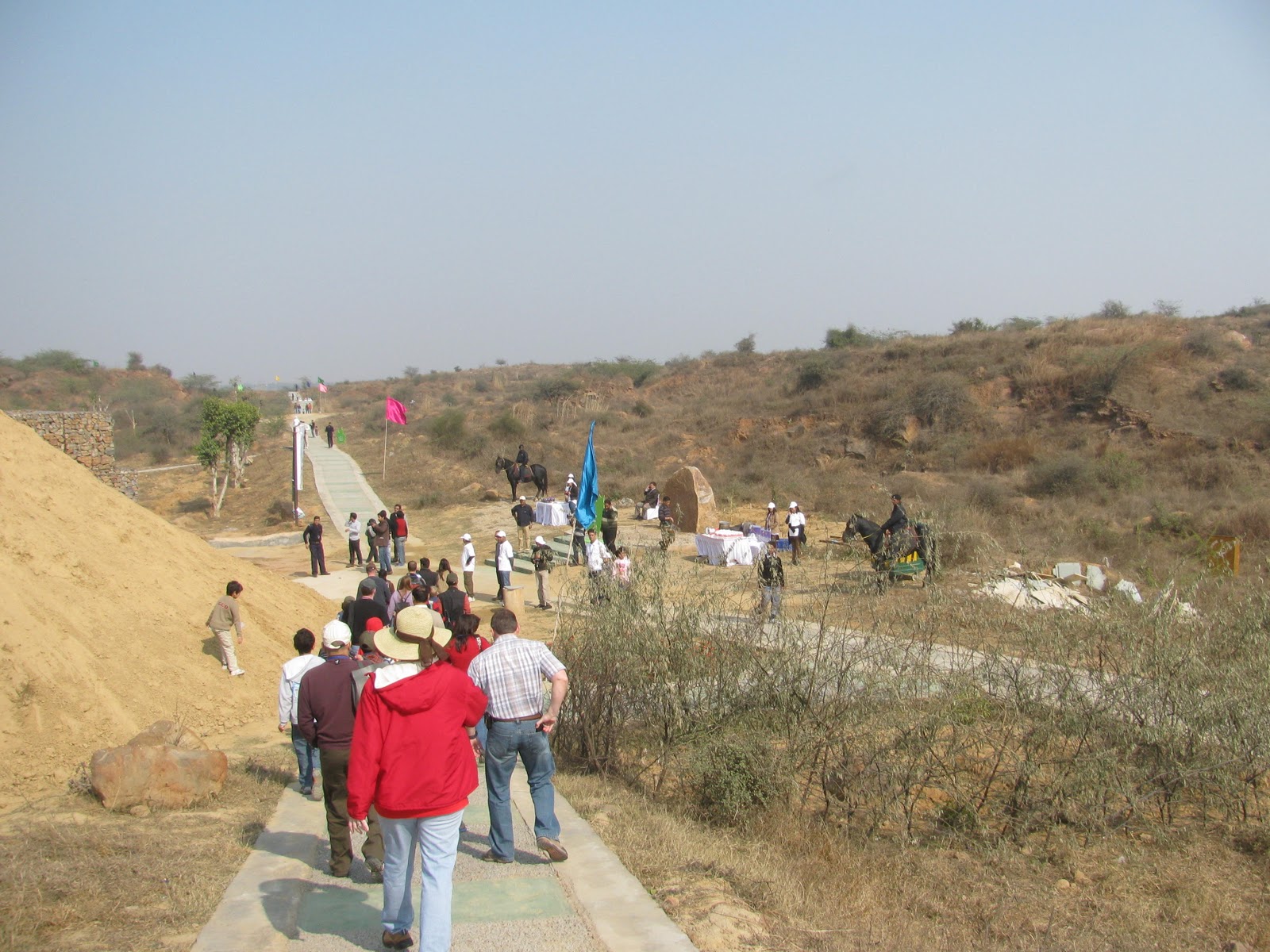
This past Sunday we took Evan's Cub Scout Pack to the Aravali Biodiversity Park in Gurgaon, Haryana. Gurgaon is a sprawling satellite city outside of Delhi, not unlike Noida. The city set-aside 562 acres of undeveloped land as a green space and natural destination for residents to enjoy. It is a huge, barren chunk of land, but the green space is sorely needed in what has rapidly become the urban chaos and hyper-construction zone of Gurgaon.
As part of earning their forestry badge, the cub scouts were invited to visit the park to learn about native species of plants, why they are important and who the trees benefit. The trees, including Neem, Peepal, Banyan, and Tamarind are all native to northern India. This re-forestation is important to help protect the arid land here from wind and water erosion and to help control the spread of non-native species. Oddly enough, one of the biggest culprita is, Mesquite. It's a thorny, shrub native to the Americas (believed to have been brought here 300 years ago by the Portuguese) and has spread like wildfire across much of northern and central India.
During a brief educational presentation, park professionals explained the many uses of the trees the boys were to plant. Extracts produced from the Neem tree, as an example, are apparently beneficial for intestine and respiratory disorders, as well as for the treatment of arthritis and many surface-skin conditions.
After a brief list of safety instructions, we were separated into small groups and hiked out on a nearby ridge to plant trees. The holes were pre-dug, and staff was present to provide help us access water, dirt and even first aid and some refreshments. The park even provided extra security for us in the form of mounted police.
As a group, the Cub Scouts and their parents managed to plant over 200 saplings during the course of about ninety minutes.
The weather was perfect for planting. The trip was a well organized, positive experienced for parents and scouts alike! The on-going project seems to be a great model for a country sorely in need of more environmental awareness, conservation and protection.

Wednesday, January 18, 2012

Cambodia's Angkor Wat

It was good to get away from India for a few weeks. Christmas is a bleak time in Delhi. We spent our first India-Christmas in Noida, and vowed to never suffer through the damp chill and fog again. The tropics are a good bandage to wrap around our distance from family and friends back home.
 A traditional meal cooked under the supervision of a British National, meters from the Gulf of Thailand doesn't hurt either...
Angkor Wat was the reason for our choice to travel to Cambodia. In many ways it proved similar to our experiences in Vietnam.. having suffered a series of wars and many, many deaths from aerial bombings and literally millions of scattered land mines. But the country is beautiful, and its people are wonderful and welcoming. And Angkor Wat was worth the wait.
The National Park, and UNESCO World Heritage Site is the heart and soul of Cambodia. It is easy to get there, well managed and enormous. Angkor Wat itself is the centerpiece of the park, but it is actually surrounded by scores of other temple complexes which stretch for many kilometers in all directions. Many are walled enclosures that have the look of fortresses. There are broad, elevated avenues to approach their many gates. And there are many small temples - monuments or tombs to lesser gods and men. All of these places range from the 10th-13th centuries.
The land is very flat here, and good signs and maps make it easy to peddle a bicycle from site to site. Or if you chose, hire a Tuk Tuk for the day (about $10) to do a grander tour and cover more distance. We managed to do both and enjoyed the unique experience of each.
A little bit of India managed to wander its way into our Cambodia travels despite our distance. The preservation and partial restoration of Ta Prohm - actually my favorite temple complex at Angkor - is being managed and funded by the Archaeological Survey of India.
We met the director and got a chance to chat with him about the ongoing work their. He laughed when he found out where we lived, because he knew Nizamuddin well. His previous position was to managed the Archaeological Survey's restoration work at Humayan's Tomb - right in our back yard! Ta Prohm is famous and frequently photographed for its Indian Jones-like appearance.
It has been intentionally left much in they way it was discovered, with huge trees and vines covering its 1,000 year-old walls and buildings.
The other famous temple here is Bayon. It's smaller in scale, but also a pleasure to photograph because of its many carved, stone faces. Audrey and Evan loved exploring its many narrow, maze-like corridors and stairways.
 Lesa and I gave up trying to keep track of them in these places. We just set a place and time to meet, reminded them about safety, respect and staying together, then unleashed them out into the confines of each walled complex. They had a blast discovering the wonders of each place. And they'd occasionally spy and giggle at us through ancient windows and between tumbled stones as we each explored at our own pace.


Friday, December 16, 2011

Filming Elephants at an Indian Wedding

A Short Documentary: Day Two

Okay, the second day of this little production went a bit more smoothly.  A friend of a friend connected our small crew with "Tony". Tony is a wedding planner who happens to specialize in Royal Weddings.  These are not weddings for Lords and Ladies or Indian Princes. No, these are just really big, very expensive, and over-the-top weddings. Think Vegas meets Jaipur.
Tony told us to meet him in a North Delhi neighborhood called Pitam Pura no later than 6pm. Delhi traffic was heavy that evening, but we managed to get there only thirty minutes late. We called Tony, who was actually not on location yet... "stuck in traffic." The wedding pavilion did not disappoint. It was massive. We passed several other pavilions before finding our destination. There is a lot of money being spent on weddings in Indnia. One of these pavillions actually had a one-third-scale Eiffel Tower in the entrance. Vegas.
Tony showed by 6:45 and gave us the drill:  two elephants, eight horses, three bands, twelve guys with mobile chandeliers (connected to a car battery and, oh yes, not to worry: 'completely safe'). There were easily over one thousand guests. The parking lot was filled with German engineering: Mercedes, BMW, Audi. The happy couple were gifted two brand new cars - a big white Ford SUV, and a white Honda sedan.
We had a great time.  Interviewed the Mahouts, filmed a huge fireworks display. The wedding goers danced in the street. The elephants who took money from well-wishers (Long trunks grasped each 100 rupee bill and gently passed them up to the mahout.  Each elephant-driver waggled his head, gave a polite "danyavad," and deftly pocketed bill after bill as they flowed upward).
Many rupees were spent on this wedding night, and although it was crazy and loud, it was full of joy.  Without a doubt, this bash was the largest wedding celebration I have ever attended. And its on film.

Day Three is scheduled for late January... so stay tuned.

Saturday, December 10, 2011

A Short Documentary, Part One

I kept seeing elephants and chatting with their drivers (mahouts). I researched where the urban elephants lived, what they ate, who actually owned them. We went to see Asian elephants in the wild in both south India and Sri Lanka. I became familiar enough with some of the drivers to arrange rides for visiting friends and family... There is a sadness about these animals. They are treated very inconsistently by their keepers, and must live by and swim in one of the worlds dirtiest rivers. But inspite of it all, they remain beautiful, intelligent, majestic animals.

When I found out their numbers were rapidly disappearing from New Delhi's urban landscape, I wondered if there was a way I could document what I was experiencing. Something that could be shared with others before the elephants disappeared completely from the streets of Delhi.

I floated the idea of making a short film with two friends of mine: a Croatian director, and a Nepali cameraman. I know absolutely nothing about producing a documentary film, but my friends were experienced (and liked the idea).  We scouted locations and found out where to hire an HD camera and digital sound equipment. Once we sketched out a probable shooting schedule of three or four good days of filming.
The camera we use for all footage is a Sony digital EX-3 High Definition system.

Our first day turned out to be a bit of a mess.  We had four locations lined up. Two fell through within the first hour of the day.  A family who owns six elephants in the village of Wazirabad skipped out on us. At 8am we were standing in a dirty village street. No promised elephants on location and no family members to interview.
 "Where is everyone?" we asked. "Sleeping... call Farukh after 11am."  We stood empty handed and looking at one another in the street. We rushed off to a back up location. There'd be elephants if we arrived before 9am.
The second location, at the edge of the Yamuna river proved to be much better.  Elephants and mahouts. We managed to record some great interviews, got footage of a Mahout giving his elephant a bath in one of the worlds dirties rivers and then filmed him painting a beautiful design on the face of his elephant, Champa
By 11am we rushed off to a third location. One of the Mahouts (elephant keeper-driver) gave us a lead on some tourists who had hired Champa for an "urban safari." More great near Delhi's famous Raj ghat Park.
By late afternoon we finally got in touch with 'Farukh', our contact for that evening's wedding location.  In a gruff voice he told us the wedding would a no-go unless we forked over 8,000 rupees... It was late and we had a strict budget. So we decided to eat instead. The day ended with a some good, home-cooked Indian food at the director's house and a review of our first day of footage Day one ended at 10:15pm

Stay tuned for episode two..."Filming Elephants at an Indian Wedding..."

Monday, November 21, 2011

Polo Match

We were invited by a friend to attend a polo match yesterday at the nearby Jaipur Polo Club. These Delhi polo grounds have been in existence since around 1900 (older than the city of New Delhi, which was established in 1911). As most know, polo was popularized by the British in the 19th Century and is now played throughout the world. But the game actually originates from right here in India. The first official Polo Club was established in India in 1834. None of us had ever gone to a formal match before, so we were excited to attend.
The grounds were beautiful and well-maintained. They are largely a product of the Indian Army. Because we weren't VIPs we didn't get a chance to see the inside of the clubhouse. But we did get to sit in very nice, covered seating. The crowd included quite a collection of expats, wealthy socialites and Delhi personalities.

The match was the 2011 Army Championship, so it was quite an affair. We walked along a red carpet to enter the pavilion. Many of the attendees were formally dressed. A few men wore dinner jackets with their Jodhpurs and riding boots. Some of the wives were adorned in pearls and high heels. The players were all current or retired Army officers and the game was face-paced. Audrey and Evan enjoyed watching the horses race by as the players whacked the ball up and down the lush, green field.
At the halfway mark it is a tradition for everyone to walk out onto the field for "divot stamping" (called the "tread-in" here in Delhi). Wine or champagne is served and the spectators socialize while everyone helps to smooth out the playing field by stomping on torn patches in the turf.
Can't help but love these moments...  attending this polo game was another unexpected opportunity and new experience for the SayerRanch... Such a lovely way to spend an Autumn Sunday afternoon with friends and family.

Monday, November 14, 2011

November 2011 Campout

Evan, Audrey and I went on an overnight camp out with Cub Scout troop 3060.  Lesa and her Mom were off to Kathmandu for the weekend so the timing was perfect! This was our second trip out to Camp Wild! near the Haryana village of Dhauj. The camp is about two hours drive from Delhi.
November is a beautiful time of year to camp or trek in India. There is little rain and the chilly enough at night to enjoy a warm campfire. I can tell you Indian's don't fool around when they ignite a bonfire.
Although we were not really that far from the bustle and crowds of Delhi, Haryana seemed like we had traveled to some far off land... Camp wild is nestled in the ancient (700 million) Aravali Mountains. The peaks there have been worn down from centuries of wind and seasonal monsoon rains. The landscape is desert. Cattle and goat herders wander across broad, dusty valleys and the rocky hillsides found throughout this region.
The kids and I were able to do a little hiking, rock climbing and Evan was able to complete parts of several steps for some of his Outdoorsman and Fitness badges.
Our little adventure gave kids and I had a nice break from the traffic and crowds of Delhi... plenty of exercise, great traditional Indian food and time shared with good friends.

Friday, November 4, 2011

The Nizamuddin Dargah

This is the mausoleum of one of the most famous Sufi Saints, Nizamuddin Auliya (or Hazrat Nizamuddin). (1238-1325).  He is the man our neighborhood here in Delhi is named for. He believed that you came closer to God through the renunciation of the world and by giving yourself over to the service of humanity. For him, his love of mankind represented his love for God. Sufism is one of the many "flavors" of the Muslim faith. I've come to admire many of the beliefs of the Sufis. Their faith, similar to the Faith of Christianity, focuses on Love. Their music is wonderful. Worshipers often represent love through art, music and song.
We took the kids and their Grandma to see this famous Dargah last night in neighboring Nizamuddin West. Every Thursday evening there is a small concert of Sufi music for followers, Sufi music aficionados, and the curious. It's free to the public and usually starts sometime after 6pm. Last night, I would guess at least 10% of the listeners were Westerners. If you go, men should wear long pants, and women should be covered - long pants, and a scarf.

The Dargah is the focus of the local mosque in our neighborhood. The mosque has been there at least since the 12th Century. The Dargah itself is from the 13th Century.
Many Pilgrims travel to the Dargah from very distant parts of India as well as the world because it is so famous in the Muslim community. There are special areas for prayers devoted to the sick, the demented, and a special Mosque for women. Ladies are not allowed inside Nizamuddin's Mausoleum, but can bring offerings, and may pray outside. 
All are welcomed here and are encouraged to listen to the music. The musicians and singers are from families who have made this music for generations. The songs are passed down from grandfather to father to son and have probably been played in this way since before the time of Hazrat Nizamuddin.

The evening was yet again, another wonderful and unique India-experience for all of us!

Thursday, November 3, 2011

Why are the Streets so Filthy in India?

I just came back from Sri Lanka after an enjoyable family trip.  As soon as I stepped out of the impressive, new Indira Gandhi Airport Terminal I was immediately struck by the contrast India presents to its visitors. Sri Lanka is obviously much smaller and probably considerably easier to manage that India ever will be.  But I have to be honest. My observations of Lanka gave me a clear impression that life is cleaner, safer, and more efficient there. And if these things are all true, Why?  Could it be just because Sri Lanka is smaller and less crowded?
I love living in India. But like any place you chose to live there are things you like and admire and some things that really bug you. For me it's the mess. Why are most of the streets here so filthy? After living here for nearly three years, I believe population and caste are probably the two biggest factors that contribute to the litter and garbage that is almost everywhere. 
In Sri Lanka the population (20 million) is only a fraction of India's (1.2 Billion). It's just not much of an issue there. But over-population obviously fuels India's ongoing struggles with infrastructure (stable electricity, clean drinking water, road maintenance and modernization). India is working hard to modernize and improve, but has yet to seriously address the issue of population. There's just a lot of people here and they aren't going anywhere anytime soon.

Sri Lankans have essentially rejected the notion of Caste. Probably because that country is predominantly Buddhist. I have witnessed few beggars, and after traveling through many small towns and villages, I have seen very few desperately poor Lankans. But is this why Sri Lanka is visibly cleaner?  It's not that there seem to be less poor people in Sri Lanka. I believe its about personal responsibility.  I think India's willingness to accept caste conveniently simplifies what people perceive to be as their personal responsibility.
Litter is the easiest example of this. And the topic of litter gets me back to the thing that really bugs me about India. In Sri Lanka I have never witnessed someone drop trash on the ground. Sri Lanka is not without litter, but Lankan streets and public spaces are generally much cleaner, better groomed and more well-maintained than India's. 

Here in India I have seen hundreds and hundreds of people drop trash on the ground without any hesitation or care. Personal drivers have littered right in front of me. Wealthy Indians on safari (right inside India's beautiful National Wildlife Preserves) have tossed empty plastic bottles and snack wrappers while standing next to me. Policeman, college students, businessmen and women, even Catholic nuns -- they have all been active participants in dumping personal trash on the ground in front of me. Often I confront them on the spot, but 1.2 billion people can generate a lot of curb-side garbage. I know not all Indians believe or value this age-old idea of caste, but I blame your mess squarely on your society's anachronistic belief that some people are above certain duties. Tell me, is it really someone else's responsibility to deal with the litter you or your organisation has discarded? (What do you think?) 

Every place I have ever been (with the possible exception of Singapore) has its own share of pollution, and litter... Americans sadly still litter, and we certainly need to drive less, buy less and use less packaging. But our streets, neighborhoods and public spaces, like Sri Lanka's, are generally cleaner. Europeans certainly need to smoke less, and the Chinese have had a knack for quickly adopting many of the West's bad behaviors. India wants its rightful place on the worlds stage - as it should have. But she will never be an equal partner in the eyes of outsiders until the population here acknowledges the visual mess it presents to the world.

I believe it's not a problem for your government to solve. Government can help though public awareness, but to actually eliminate the waste - the trash that is just about everywhere... That is all about acknowledging personal responsibility. If there is a dustbin, please use it. If there isn't one, hold on to your garbage until you find one. Take charge. Don't just clean up your yard, clean the street in front of your house (or if you can afford it, pay someone to do it for you).  Organize your neighbors to clean up and maintain your block, your neighborhood park. If you think it looks messy, I REALLY think it looks messy. And above all, if you see someone else litter, give them a hard time about it. It's not someone else's role to do it for you.
Like it or not, until these habits improve, I believe places like Sri Lanka will always look brighter and cleaner to her visitors. Lankans may even be a little happier despite their own share of the world's problems.