Thursday, October 20, 2011

It's What?

Okay, We've been living in India for nearly three years... and buying milk here all of that time. For the first few months we were nervous about almost everything, so when it came to milk we bought the safest alternative - milk in a processed box with a shelf-life of 12 months. But milk in this form is about three times the cost of local milk and it really doesn't taste very good.

 As with most things, we got over our milk-anxiety and started buying it the way most people get it here - in little plastic pouches from the neighborhood Mother Dairy stand. Their milk is delivered fresh each morning and it comes in a variety of forms - slim, creamy (double toned), really creamy (toned), and full cream. Three years, right?...
photo credit: C. Hildreth

Cows are everywhere in India, so of course I assumed what we were drinking was, well... cow's milk. Nope. Yesterday we found out what we've actually been drinking is buffalo milk.  That's right, Water Buffalo.
Hmmmm... I suppose that does explain that oddly musky flavor.

Namaste, y'all.

Monday, October 17, 2011

Suburban Camping

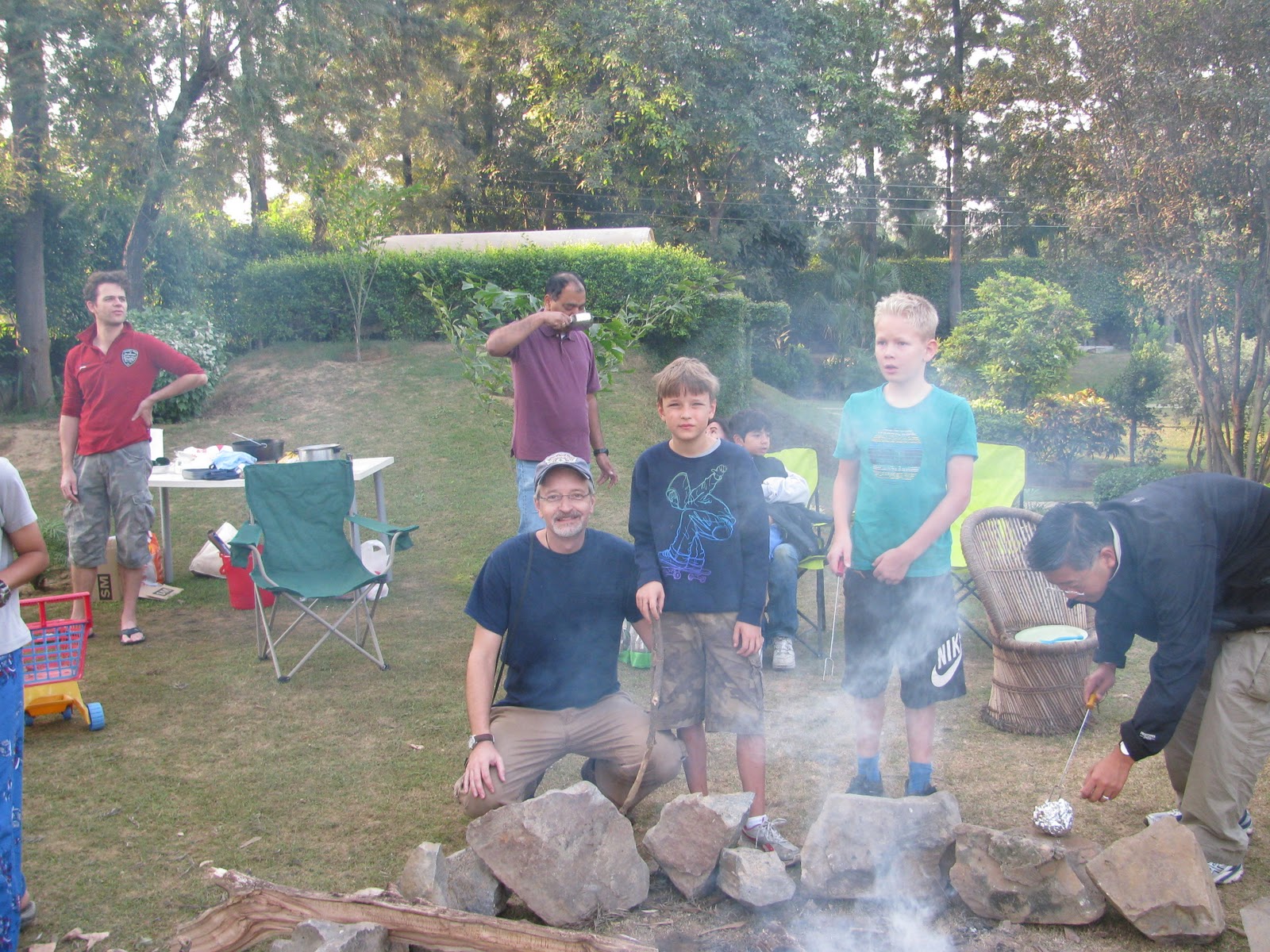
Evan and I had an overnight camping experience with his Webelos Den... It was a good trip for the boys, but also a new experience for me... the first time I had witnessed a truly "Suburban" lifestyle in India.

The "camp" was in one of the scouts' backyards - graciously offered up to us by his parents. It was located in a neighborhood called Sultanpur. It's a residential area in SW Delhi where there are multiple residential developments with properties quaintly referred to as "Farm Houses" here. I was expecting a few cows, horses, a barn... at least maybe some chickens wandering about the place.

Nope. 

A "farm house" is essentially an American or European-style home on a plot of land that has 1-3 acres of yard... suburbia.

Granted these are very nice suburban neighborhoods. The streets are swept and manicured (no piles of garbage or wandering livestock) Many are gated, and all of the properties within these developments are walled compounds with guardhouses and multiple forms of security. Our space had a nice California-style home, gardens, an in-ground pool and a cottage in the back for staff.  Oh, and it takes a lot of staff... These "farmhouses" have multiple guards (at least 4 to cover 2 twelve hour shifts), 2-3 gardeners to manage the landscaping, housekeepers, 1-2 drivers, a cook and typically an ayah (nanny) if there are small children at home. That's quite a payroll!
Once I recovered from the "Farmhouse" reality, the campout was a whole lot of fun. Our hosts provided a lovely yard to pitch the tents in, we had access to a poolhouse for toilets, and washroom. There was clean drinking water, Tang, coffee and hot cocoa and the gardeners had collected plenty of wood for our campfire/cookfire. The weather was perfect... warm during daylight, cool and pleasant at night. The night-sky was clear and the moon was bright! After the boys settled down to sleep, the Dads had a few moments to relax a bit.. We sipped red wine, and had a taste of scotch and smoked cuban cigars by the glow of the campfire.

Webelos are responsible for learning how to pitch and take down their own tents, cook and clean up at mealtimes and maintain campfire safety. So the campout was a good learning experience for Evan and his friends. Of course it also showed me there is still much to learn about all of the possibilities associated with life and living here in India.

Wednesday, September 28, 2011

Rooftop Bakery

A friend and I decided to explore the streets of Old Delhi with our cameras the other day. We'd both been there many times before, but this historic area is a place that always manages to offer the unexpected. The neighborhood is full of narrow alleyways, crowded market streets, and an odd assortment of shops, cafes and places of worship. If you know where you're going and are comfortable diving into the crowds, Old Delhi is best to explore on foot.
For some reason that morning we wound up on a rooftop five stories above the street level. We wanted a "bird's-eye" view and quickly found one above the spice market district in Chandni Chowk.
Our eyes first drifted to the horizon.
The massive Jama Masjid Mosque could be seen through the haze in the distance. It's very impressive and draws crowds of pilgrims from all across India (and the world) each day.
Our interest was next drawn below to the crowded market streets. These are almost always busy, each filled with sellers, buyers, shippers and shoppers. Scores of hand carts, day laborers and stockpiles of canvass-covered bales make the scene look like something from a much earlier era.
While observing the controlled chaos of the street below we heard an oddly repetitive sound. Not quite a banging, more of a repeated "bump, bump, bump - slap!"  We worked our way around the edge of the roof until we discovered the source of the noise. A young man was working, perhaps two stories below on a neighboring rooftop. He was hunched underneath an improvised bamboo shelter, pushing, rolling and slapping dough with his hands. We had discovered a bakery!
The baker was very strong, his back was glistening with sweat from the motion of his hard work. He moved in a constant rhythm and was surrounded by hundreds of dough-balls and scores of flat disks called papad. The results of his efforts were neatly laid out in many rows across large flats of bamboo where they baked in the midday sun.
Papad is a thin, crispy disk (roti) made of besan flour (chick pea), black pepper and other spices. Traditionally eaten with biryani, they are also served as an appetiser or snack (namkeen) before, during and even after meals.
I've eaten and enjoyed papad many times, but it never once occurred to me that these crispy treats were baked beneath the hot, Indian sun on a rooftop in the middle of Old Delhi.